Version 7: Sat, Dec 28, 2024

Image: Red square Moscow cityscape - by Valerii Tkachenko -
Wikipedia.
National Policy Issues
2020 Constitutional Amendments
Law on amendment to
Russian Federation Constitution - Official announcement - March 14,
2020
The President signed the Law of the Russian Federation on introducing
an amendment to the Constitution of the Russian Federation, On Improving
the Regulation of Certain Aspects of the Organisation and Functioning of
Public Authority
The Federal Law was approved by the State Duma and the Federation
Council on March 11, 2020, and as of March 14, 2020, has been approved
by legislative (representative) bodies of 85 constituent entities of the
Russian Federation.
The
Content of the 2020 Constitutional Amendments in Russia by Sergei
Belov - The International Association of Constitutional Law (IACL-AIDC)
Blog - Apr 01, 2021
Sergei Belov is Associate Professor of Constitutional Law, Chair of
Constitutional Law Department, and Dean of the Law Faculty,
St. Petersburg State University.
Russia’s Foreign Policy
Concept
The
Concept of the Foreign Policy of the Russian Federation Approved by
Decree of the President of the Russian Federation - 31 March 2023 -
(@MFA_Russia)
Russia’s Nuclear Doctrine
Fundamentals
of State Policy of the Russian Federation on Nuclear Deterrence (3
December 2024) - Approved by the Executive Order of the President of the
Russian Federation No.991 of November 19, 2024
Russia’s
new nuclear doctrine ready – Kremlin RT - 29 Sep, 2024 - Archive
The changes to the document were necessary in light of growing
Western involvement in the Ukraine conflict, Dmitry Peskov has said
The update was proposed by Russian President Vladimir Putin on
Wednesday, who said that the nuclear strategy should consider
“aggression against Russia by any non-nuclear state, but with the
participation or support of a nuclear state,” as a “joint attack” that
would trigger a nuclear response. The new rules could apply to a
possible Ukrainian attack deep inside Russia with advanced weapons
supplied by the West, or in case of a “massive” missile strike launched
by Kiev against Russia or its closest ally, Belarus.
Interviews
Nuclear
Conflict Risk, Ukraine, And Syria Escalation: Watch Lavrov’s interview
with Tucker Carlson (With Full Transcript) Tucker Carlson talks with
Sergei Lavrov - RT - Thu, 05 Dec 2024 - SOTT
copy
Pivot to the East

By
M.Bitton
- Own work,
CC
BY-SA 3.0,
Link
Orthographic map centred on Siberia - Wikimedia
Dmitry Trenin in his article: Russia is undergoing a new,
invisible revolution (link below)
Unlike in the previous decade, when Russia’s “turn to the east” was
first announced, these are not just words. Our trade partners, not just
political interlocutors, have also switched places. In just two years,
the European Union, which only recently accounted for 48% of foreign
trade, is down to 20%, whereas Asia’s share has soared from 26% to 71%.
Russia’s use of the US dollar has also plummeted, with increasingly more
transactions being conducted in Chinese yuan and other non-Western
currencies such as the Indian rupee, the UAE dirham, as well as the
instruments of our partners in the Eurasian Economic Union, and the
ruble itself.
Sergey Karaganov in his article: Here’s why Russia must
permanently abandon Europe and turn fully to Asia (link
below)
He recognizes that Russia had a close relationship with Europe but
that is now coming to an end:
The war provoked and unleashed by the West in Ukraine should not
distract us from the movement towards the south and the east – where the
center of human development is shifting. This new, but long foreseen,
situation calls us to return to our “home.” A European journey of more
than 300 years has given much, but long ago – a century ago, in reality
– and has exhausted its usefulness.
Karaganov argues for a reorientation of Russia’s development strategy
towards Siberia and Southeast Asia:
Now, the new geostrategic situation urgently requires a return to the
original idea – the eastward turn of all of Russia through the primary
development of all of Siberia, including, of course, the Urals. In other
words, we are talking about the “Siberization” of the whole country.
Western Europe will be closed for many years and should never again
become a first-class partner, while Asia is developing rapidly.
He continues later on and clearly going beyond economic
considerations (emphasis added):
The reorientation of the self-awareness and thinking of all our
compatriots, the unity with the glorious Siberian past, present and
future in the interests of the whole country will certainly find an echo
in the hearts of the Siberians themselves. I repeat, we need a
Siberian strategy for the whole of Russia, not just for the Urals,
Siberia and the Far East.
The strategy should start not so much with dry economic calculations,
although the existing ones are more than convincing – Novosibirsk
scientists are exceptional – but with the spiritual and cultural
return of the magnificent, breathtaking history of the exploration of
Asian Russia to the center of Russian identity.
Practical proposals include:
- If Peter were alive today, he would certainly have founded a new
capital in Siberia and greatly expanded the window to Asia. Along with
Moscow and St. Petersburg, Russia desperately needs a third, Siberian
capital. The military-strategic situation that will develop in the
coming decades demands it.
- New meridional routes should be built, connecting southern Siberia
with the Northern Sea Route, leading to China and through it to
Southeast Asia.
- It is necessary to rebuild the Siberian machine-building industry on
a modern basis, taking advantage of the flow of orders to defense
enterprises.
- It is necessary to develop Siberia with its water resources,
involving water-scarce, but labor-abundant Central Asian countries.
- We also need a national program for the development of Oriental
studies, knowledge of Oriental languages, peoples and cultures in
schools. Uniquely, culturally and religiously open Russia has a huge
competitive advantage here, inherited from its ancestors who, unlike the
Europeans, did not enslave and destroy but absorbed local peoples and
cultures as they moved eastwards.
2024 BRICS Summit -
Kazan, 22–24 October 2024

By
Prime Minister’s Office
(GODL-India),
GODL-India,
Link
BRICS representatives at the 2024 summit, from right to left: Mauro
Vieira, Masoud Pezeshkian, Mohamed bin Zayed, Narendra Modi, Vladimir
Putin, Xi Jinping, Cyril Ramaphosa, Abdel Fattah el-Sisi and Abiy Ahmed
- Wikimedia.
Summit’s main theme was “Strengthening Multilateralism for Fair
Global Development and Security.”
Official site: Russian 2024
BRICS Chairmanship - Documents
The
Kazan BRICS Declaration — a New World Order Manifesto by Zhao
Huasheng and Andrey Kortunov - Russian International Affairs Council -
October 28, 2024
BRICS
post-Kazan: A laboratory of the future by Pepe Escobar - The Cradle
- Oct 30, 2024
The much-awaited BRICS heads of state meeting in Russia’s Kazan did
not disappoint. The multilateral institution has finally brought bite
and substance to many of the global financial and political conundrums
that have long-challenged a genuine reshaping of the global order.
Rag
Picking Through The Kazan Declaration – What President Putin Gained,
What He Lost From BRICS 24 by John Helmer (@bears_with) - Archive
No, BRICS Isn’t Trying to Rival
the West: The declaration from last week’s summit reads like a cri de
coeur for the existing order By Nicholas Bequelin, senior fellow at
Yale Law School’s Paul Tsai China Center and the former Asia-Pacific
director of Amnesty International - Foreign Policy - Oct 30, 2024
And a globalist take on the summit:
BRICS
looks increasingly like a paper tiger By Herbert Poenisch - Official
Monetary and Financial Institutions Forum - 29 October 2024
“OMFIF is an independent think tank for central banking, economic
policy and public investment, providing a neutral platform for public
and private sector engagement worldwide. With teams in London and the
US, OMFIF focuses on global policy and investment themes relating to
central banks, sovereign funds, pension funds, regulators and
treasuries. Global public investors with investable assets of $43tn are
at the heart of this network.”
Neo-Ottoman
NATO Member Turkey in BRICS? Is It Really a Good Idea? By Drago
Bosnic - Global Research, September 06, 2024 - Archive
There’s virtually not a single US-orchestrated war that hasn’t been
supported by Turkey, in one way or another. Whether it was in Korea,
Yugoslavia or anywhere in the Middle East, Ankara has been working in
concert with Washington DC since the 1950s. Nowadays, this is most
evident in countries like Syria and Libya, where they directly support
the same terrorist groups.
By
Kaiserc
- Own workPublic domain map
by
EIA:
File:Former
USSR Oil and Gas map.svgInformation on the route taken from the
Russian Wikipedia’s
article
by: (see authors at the
history
page),
CC0,
Link
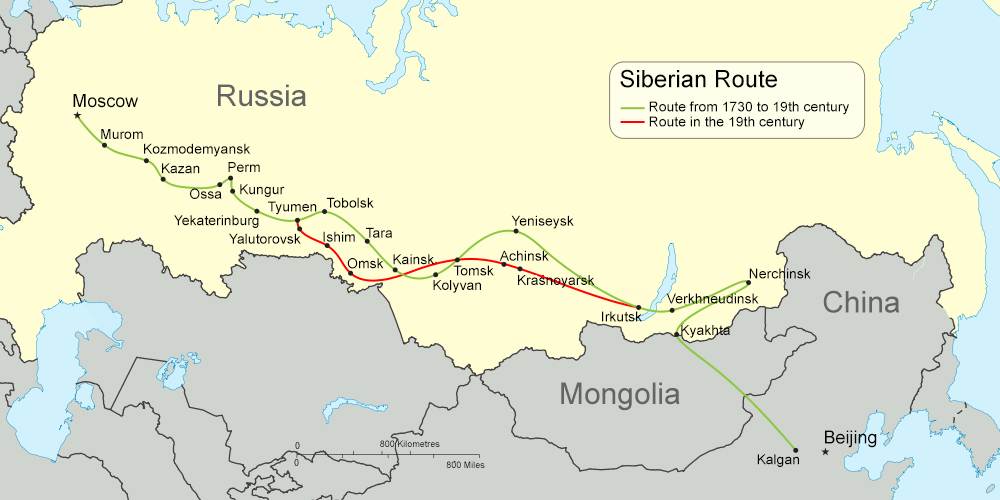
Map of the Siberian Route in the 18th century (green) and the early
19th century (red)
Academics and Officials
Timofey Bordachev
Timofey Bordachev Program Director of the Valdai Club.
Ukraine
in the EU will only exacerbate the bloc’s growing irrelevance by
Timofey Bordachev - Aug 26, 2023 - Archive
The
EU is now dealing with the consequences of its huge strategic
failure by Timofey Bordachev - Dec 14, 2023 - Archive
Serbia -
The West hates this small country almost as much as Russia. Here’s
why by Timofey Bordachev - 3 Apr, 2024 - Archive
This
major pillar of Western civilization is crumbling. Here’s why: The
collapse of the middle class is driving the abandonment of a system we
believed was here to stay By Timofey Bordachev, Program Director of
the Valdai Club - 15 Apr, 2024 - Archive
Olga Butorina
Dr. of Science (Economics), Corresponding Members of the Russian
Academy of Sciences, Professor, Deputy Director for scientific work, RAS
Institute of Europe, RIAC Member
The
Draghi report interrupts the EU silent “family dinner” by Olga
Butorina - RIAC - October 11, 2024 - Excerpts (emphasis added):
Economic growth was a top priority for the EU since its
inception. This changed, however, in late 2019 when a new European
Commission led by Ursula von der Leyen took office, shifting focus to
the European Green Deal (i.e., achieving climate neutrality by
2050), digital transformation and building an economy that works for
people.
The EU share of world GDP has been steadily shrinking lately,
dropping from 21.8% in 2010 to 17.5% in 2023. In the meantime, the US
share rose from 22.5 to 26.0%, and China’s share jumped from 9.2 to
17.0%. In 2021, for the first time ever, China overtook the EU by
nominal GDP, finishing the year at $17.8 trillion versus the EU’s $17.3
trillion.
Perhaps no economist in the EU enjoys the same international acclaim
as Mario Draghi. …
This is why the competitiveness report presented by Draghi deserves
our full attention. It busts the myth that the green agenda
makes growth irrelevant. Speaking with his usual candour,
Draghi states in a separate paragraph, “Europe’s need for growth is
rising.” He explains that the EU faces greater competition on global
markets today, that it has lost Russia as its key energy supplier, and
that it is weak in emerging technologies, in part because it largely
missed out on the digital revolution. In addition, the demographic
situation looks bleak: by 2040, the EU workforce is projected to shrink
by 2 million workers each year.
Sergei Glazyev
Russian
Economist Sergei Glazyev Praises the Thinking of Lyndon LaRouche, on the
Centenary of His Birth - Executive Intelligence Review - Sept. 12,
2022
Russia’s
Sergey Glazyev Introduces the New Global Financial System by Pepe
Escobar - April 24, 2022 - Archive
Sergey
Glazyev: ‘The road to financial multipolarity will be long and
rocky’ by Pepe Escobar - Mar 13, 2024 Archive
Rocky
Road to Dedollarization: Sergei Glazyev Interview by Pepe Escobar -
Feb 28, 2024 - Archive
Sergei A. Karaganov
Sergey Karaganov is honorary chairman of Russia’s Council on
Foreign and Defense Policy, and academic supervisor at the
School of International Economics and Foreign Affairs, Higher School of Economics (HSE) in
Moscow. From their site:
We are ranked among the top 100 institutions worldwide in Politics
& International Studies, Sociology, History, Economics &
Econometrics in the QS – World University Rankings by Subject.
“Russia
cannot afford to lose, so we need a kind of a victory”: Sergey Karaganov
on what Putin wants: A former adviser to the Kremlin explains how Russia
views the war in Ukraine, fears over Nato and China, and the fate of
liberalism By Bruno Maçães - New Statesman, 24 February 2023 - Archive
Russia
is abuzz: The use of nuclear weapons can save humanity from a global
catastrophe – Sergey Karaganov Global South, June 15, 2023 - Archive
Russia’s
European Journey is Over Evgeny Shostakov, in conversation with
Sergey Karaganov - Global South, January 6, 2024 - Archive
Here’s
why Russia must permanently abandon Europe and turn fully to Asia:
Europe is finished, and Russia’s geographical and cultural advantages
means it doesn’t have to go down with the sinking ship By Professor
Sergey Karaganov - Russia Today, Feb 10, 2024 - Archive
Geopolitical
paradigm shifts and coping with psychopaths Tariq Marzbaan and Nora
Hoppe interview Professor Sergei A. Karaganov - May 9, 2024 -
(@MayadeenEnglish) - Archive
Decades
of Wars? by Sergei A. Karaganov - May 24, 2024 - Russian
International Affairs Council - Archive - Excerpts and discussion of
this paper by T. Fazi below.
Russia
must update nuclear doctrine to bolster deterrence - Former Kremlin
advisor Sergey Karaganov By Al Mayadeen English - 12 Sep 2024 - Archive
Former Kremlin advisor Sergey Karaganov has urged Russia to revise
its nuclear doctrine, advocating for a more aggressive stance that
includes the possibility of a nuclear response to any major military
aggression.
Andrey Kortunov
Ph.D. in History, Academic Director of the Russian International
Affairs Council, RIAC Member
What
BRICS Cannot and What It Can Deliver by Andrey Kortunov - Russian
International Affairs Council - October 23, 2024
Dmitry Moiseev
PhD in Philosophy, Senior Lecturer at the HSE University
The
U.S. Election and the Post-Westphalian World by Dmitry Moiseev et
al. - RIAC - November 6, 2024
Additional authors:
- Maxim Sigachev PhD of Political Science, Research Fellow at Primakov
National Research Institute of World Economy and International Relations
(IMEMO), Russian Academy of Sciences
- Sergei Arteyev Ph.D. in Political Science, Research Associate at the
Institute of World Economy and International Relations of the Russian
Academy of Sciences (IMEMO); Senior Lecturer at MGIMO University
- Pavel Skakun Independent researcher, lecturer at Dostoevsky Omsk
State University
Tamara Ryzhenkova
Tamara Ryzhenkova (Рыженкова
Тамара Алексеевна) is an orientalist, senior lecturer at the
Department of History of the Middle East, St. Petersburg State
University and an expert for the ‘Arab Africa’ Telegram channel
‘Colonization
of the soul’: What made a European power fear this language? After many
years of French language domination, former colonies in Africa are
returning to their cultural roots by Tamara Ryzhenkova - RT - Thu,
03 Oct 2024 - Archive
In the 19th century, many European powers, including France,
colonized Africa. From the outset, France waged a fierce campaign
against Islamic culture and the Arabic language, striving to eliminate
it from social and academic life and replace it with French. Colonial
administrator Colonel Paul Marty, who served in Tunisia and Morocco and
was an expert in the Arabic language, wrote about this in his book ‘Le
Maroc de Demain’ (‘The Morocco of Tomorrow’), published in 1927.
“We must rigorously combat any attempt to provide education in
Arabic, any intervention from Sharia scholars, and any manifestation of
Islam. Only this way will we attract children, only through our own
schools.”
Dmitry Trenin
Dmitry Trenin, a research professor at the Higher School of Economics
and a lead research fellow at the Institute of World Economy and
International Relations. He is also a member of the Russian
International Affairs Council (RIAC).
Russia
is undergoing a new, invisible revolution by Dmitry Trenin - RT -
Tue, 02 Apr 2024 - Archive
Valentin Katasonov
Professor, Department of Moscow State Institute of International
Finance, doctor of economic sciences, corresponding member of the
Academy of Economics and Commerce. He was consultant of the United
Nations (1991-1993), member of the Advisory Council to the President of
the European Bank for Reconstruction and Development (EBRD) (1993-1996),
head of the Department of international monetary relations of the
Ministry of Foreign Affairs Russia (2001-11)
Anglo-American
money masters as the organizers of the Second World War by Valentin
Katasonov - Strategic Culture Foundation - Sun, 03 May 2015 - Archive
Fyodor Lukyanov
Editor-in-chief of Russia in Global Affairs, chairman of the
Presidium of the Council on Foreign and Defense Policy, and research
director of the Valdai International Discussion Club.
Julian
Assange has become a symbol of resistance to the US government by
Fyodor Lukyanov - RT - 26 Jun, 2024 - Archive
Yevgeny Primakov
Lavrov predicts historians
may coin new term: the Primakov Doctrine - TASS - Archive
Edward Lozansky
Edward Lozansky is an academic currently working at:
Bio info from TNT Radio:
Edward Lozansky graduated from the Russian National Research Nuclear
University and obtained his Ph.D. in theoretical nuclear physics at the
Kurchatov Institute of Atomic Energy, equivalent to Los Alamos Lab. He
was forced into exile in 1976 for criticizing Soviet foreign and
domestic policies. After immigrating to the United States, he worked as
a researcher at the Laser Fusion Lab at the University of Rochester, NY,
and as a professor at the American University in Washington, DC.
Following the collapse of the USSR, he founded the American University
in Moscow to promote US-Russia science and educational exchanges. He
currently serves as a professor at the National Research Nuclear
University and Moscow State University and is the author of 14 books and
several hundred science and political science articles in American and
Russian media.
Edward
Lozansky on Connecting the Dots with Matt Ehret ~56 min - Sunday Jan
28, 2024 - (@TNTRadioLive)
Edward Lozansky was close to the people involved in all the
negotiations between Russia and the West starting in the 1980s and gives
insights on the evolution of the geopolitical relationship since
then.
Edward Lozansky’s commentary on Russia and geopolitical issues: New Kontinent
Authors and Journalists
Alexander Dugin
Multipolarity:
An Era of Great Transition by Alexander Dugin - April 1, 2024 - Archive
Tucker
Carlson releases interview with Russian philosopher Aleksandr Dugin:
They discussed ‘new liberalism’ and its role in the fate of Western
civilization (@RT_com) - 29 Apr, 2024 - Archive
Klaus Schwab,
Transgenderism, and AI ~21min Tucker Carlson talks with Russian
Philosopher Aleksandr Dugin
Sergey Poletaev
Sergey Poletaev is an information analyst and publicist, co-founder
and editor of the Vatfor project on Telegram.
Putin
just announced Russia’s own Monroe Doctrine by Sergey Poletaev - RT
- Archive
On September 26, Russian President Vladimir Putin announced updates
to the Foundations of State Policy of the Russian Federation in the Area
of Nuclear Deterrence. The revised document implies that under certain
conditions, Moscow may consider a proxy war against itself as
justification for using nuclear weapons.
Western viewpoints on Russia
American
Censorship Intensifies in the Information War: Some reflections after
being cancelled / banned by YouTube by Glenn Diesen - Oct 05, 2024 -
Substack - Archive
This is not about Russia directly, but is interesting because Glenn
Diesen is an academic critical of NATO expansionism.
The Geographical Pivot of History by H. J. Mackinder
- The Geographical Journal Vol. 23, No. 4 (Apr., 1904),
pp. 421-437 (17 pages) - The Royal Geographical Society (with the
Institute of British Geographers) - Famous paper available on a number
of sites.
The
UC Interview Series: Sir Roderic Lyne Nikita Gryazin with Sir
Roderic Lyne, KBE CMG, a former British diplomat who served in various
positions from 1970 to 2004 - Archive
Nikita Gryazin (@NikitaGryazin) holds a Master of Philosophy degree
in International Relations from the University of Oxford, where he
focused on the UK’s global positioning post-Brexit, and a Bachelor’s and
Master’s degree in International Relations from HSE University in
Moscow. He is a native Russian speaker and fluent in English, with basic
knowledge of Ukrainian, Italian, and German.
Mystery
of enmity? Ian Proud, author of ‘A Misfit in Moscow: How British
Diplomacy Failed in Russia’ Oksana Boyko is joined by Ian Proud, a
former British diplomat and author of A
Misfit in Moscow: How British diplomacy in Russia failed, 2014-2019
by Ian T. Proud (2023) - RT - Mar 3, 2024 - Archive
Inside
the Russian mind by Thomas Fazi - Jul 01, 2024 - Archive
Understanding the contemporary Russian mindset and “spirit” through
the work of Sergey Karaganov, one of Russia’s most influential
(geo)political thinkers
Started: Tue, Mar 5, 2024
About
Metagora


.svg#/media/File:Siberia_(orthographic_projection).svg)
.jpg#/media/File:16th_BRICS_Summit_family_photograph_(2024).jpg)


