Version 1: Fri, Oct 2, 2026

Grok generated image: Milei on the left, Thiel on the right.
Peter Thiel moved his family to Argentina. Many reasons have been proposed so far, but can there be an esoteric one too? Are Milei and Thiel ‘esoteric brothers’ so too speak? Not quite but definitely in the same ‘neighborhod’. Behind all the “techno-utopia” there are some very strange ideas.
Prompt
President of Argentina Milei is a student of Hasidic Judaism. Peter Thiel on the other hand lectures on Antichrist and Armageddon. Please compare and contrast Hasidic eschatology with Thiel’s ideas. Also how would the Roman Catholic Church view them?
Claude.AI
Hasidic Eschatology vs. Peter Thiel’s Antichrist Theology, and the Catholic View
A caveat on the premises
- Milei is not formally a Hasid. He was raised Catholic, studies Torah and Talmud with Rabbi Shimon Axel Wahnish, and has publicly shown affinity for Chabad-Lubavitch, including visits to the Rebbe’s grave in Queens. “Student of Judaism with Hasidic/Chabad sympathies” is more accurate. He has not given a systematic account of his eschatology, so any comparison is with Hasidic thought generally, not with Milei’s own views.
- Thiel is an Episcopalian-raised Christian whose thought draws heavily on René Girard, Carl Schmitt, and Leo Strauss. His 2025 lecture series on the Antichrist (San Francisco, hosted by the ACTS 17 Collective) is the main recent source. It was widely covered in the press but is not an academic text, so I’d verify details against the recordings or reliable reporting (e.g. Time, though check what they have published on it).
1. Hasidic eschatology in brief
Hasidism is not monolithic. Several strands matter here:
- Baal Shem Tov: In his famous letter to his brother-in-law, the Messiah arrives when his teachings “spread outward” (yafutzu ma’ayanotekha huzah). Redemption is tied to spiritual and mystical diffusion, with a strong inward, psychological emphasis.
- Classical Hasidism generally: Messianism is internalized and de-catastrophized (Scholem’s famous “neutralization” thesis, which has been much debated). The focus is on devekut (cleaving to God) and birur (the elevation of divine sparks) in everyday life.
- Breslov: Nachman’s thought has a stronger apocalyptic and redemptive drama, including the “birth pangs” of the Messiah (hevlei mashiach).
- Chabad-Lubavitch: Distinctively activist and imminent. Mitzvah campaigns are meant to “make the world a dwelling place for God” and hasten redemption. Schneerson’s followers developed an intense messianism, and a faction identified the Rebbe himself as Messiah (the subject of the Berger and Wolfson works below).
- Satmar (Teitelbaum): Opposes Zionism as a forced, premature “end,” a reading of the “three oaths” tradition. This is a sharp contrast with the Chabad and religious-Zionist styles.
- Antagonist figures: Rabbinic literature has Gog and Magog (Ezekiel 38–39) and the figure of Armilus in medieval apocalypses. Hasidism, however, generally does not center on a personal “Antichrist.” The adversary is largely internal (the yetzer hara, the kelipot) and the drama is one of repair (tikkun), not of unmasking a final enemy.
2. Thiel’s framework in brief
- Girardian core: Violence, scapegoating, and the Cross, which exposed the scapegoat mechanism. Modernity is shaped by Christianity’s revelation of the victim, which produces both sympathy for victims and a new danger.
- Antichrist as a political figure: Rather than a lone satanic ruler, Thiel treats the Antichrist as a global, totalizing order that gains power by promising “peace and safety” (cf. 1 Thess 5:3) in response to existential risks (nuclear, AI, climate, pandemics). Fear of Armageddon becomes the engine of world government.
- The katechon: Following Schmitt’s reading of 2 Thess 2, he asks what “restrains” the Antichrist. Thiel treats this as a live political question.
- Political theology: The Antichrist is a risk of centralized, technocratic, secular salvation, and he has a libertarian-leaning wariness of regulation and supranational governance.
3. Compare and contrast
| Theme | Hasidic (esp. Chabad) | Thiel |
|---|---|---|
| Nature of the end | Redemption through repair; a messianic age that completes the world | Apocalyptic crisis with a false peace preceding true consummation |
| The adversary | Largely internal or cosmic (kelipot, evil impulse); Gog/Magog and Armilus on the margins | A concrete, historical-political force: a world order promising safety |
| Human agency | Strong: mitzvot actively hasten redemption | Ambivalent: resist the false saviour and the “restrainers” may delay the end |
| Role of technology | Can be sanctified (Chabad uses media and tech for outreach) | Double-edged; AI and risk-management may serve the Antichrist |
| Violence and scapegoating | Not a central category | Central (Girard) |
| Authority | Rebbe/rabbinic tradition and halakhic framework | Scripture read through Girard, Schmitt, and political philosophy |
| Mood | Optimistic and imminent (Chabad), though Breslov has darker notes | Watchful, wary of utopian projects |
Real overlaps: both are suspicious of utopian human-engineered redemption, both see history as having spiritual stakes, and both treat the “final” era as a time of testing. Key difference: for Thiel the main danger is a counterfeit political salvation, while for Hasidism the main work is inward and communal sanctification.
4. How the Catholic Church would likely view them
There is no official Vatican assessment of either, so this is an inference from Catholic teaching.
- On Antichrist and the end: The Catechism of the Catholic Church §§675–677 describes a final trial that shakes believers’ faith, “the supreme religious deception” of the Antichrist, and a pseudo-messianism in which humanity glorifies itself in place of God. It also explicitly rejects “the intrinsically perverse political form of a secular messianism” (§676). Thiel’s emphasis on counterfeit political salvation therefore resonates with Catholic teaching, though Catholic authorities would be wary of identifying specific living individuals (such as the figures he has reportedly named) as the Antichrist. Catholic tradition treats such identifications cautiously.
- On the katechon: This is a contested, Schmittian reading. Catholic exegesis (Aquinas, Newman, Ratzinger) has varied in interpreting the “restrainer,” and a politicized version would meet theological skepticism.
- On Hasidic eschatology: After Nostra Aetate (1965), the Church affirms that God’s covenant with the Jewish people was never revoked. The Pontifical Biblical Commission’s 2001 document treats Jewish messianic hope as legitimate, while Catholics hold that Christ is the fulfilment. Chabad’s messianism would be seen as a differing interpretation of that hope, not as an Antichrist-type error. Catholic–Jewish dialogue has also avoided mission or conversion efforts.
- On Girard: Catholic theologians have engaged him widely, with some (e.g., Raymund Schwager) developing his ideas constructively. Others are critical of his reading of sacrifice and atonement.
5. Bibliography
Hasidism and Jewish messianism
- Scholem, Gershom. The Messianic Idea in Judaism and Other Essays on Jewish Spirituality. New York: Schocken Books, 1971.
- Scholem, Gershom. Major Trends in Jewish Mysticism. New York: Schocken Books, 1941 (and later eds.).
- Idel, Moshe. Messianic Mystics. New Haven: Yale University Press, 1998.
- Etkes, Immanuel. The Besht: Magician, Mystic, and Leader. Waltham, MA: Brandeis University Press, 2005.
- Green, Arthur. Tormented Master: A Life of Rabbi Nahman of Bratslav. University, AL: University of Alabama Press, 1979.
- Ravitzky, Aviezer. Messianism, Zionism, and Jewish Religious Radicalism. Chicago: University of Chicago Press, 1996.
- Berger, David. The Rebbe, the Messiah, and the Scandal of Orthodox Indifference. Oxford: Littman Library of Jewish Civilization, 2001.
- Wolfson, Elliot R. Open Secret: Postmessianic Messianism and the Mystical Revision of Menachem Mendel Schneerson. New York: Columbia University Press, 2009.
Antichrist, Girard, and political theology
- McGinn, Bernard. Antichrist: Two Thousand Years of the Human Fascination with Evil. New York: Columbia University Press, 2000 (orig. HarperSanFrancisco, 1994).
- Girard, René. Battling to the End: Conversations with Benoît Chantre. East Lansing: Michigan State University Press, 2010.
- Girard, René. The Scapegoat. Baltimore: Johns Hopkins University Press, 1986.
- Thiel, Peter. “The Straussian Moment.” In Politics and Apocalypse, edited by Robert Hamerton-Kelly, 189–218. East Lansing: Michigan State University Press, 2007.
- Schmitt, Carl. The Nomos of the Earth in the International Law of the Jus Publicum Europaeum. Translated by G. L. Ulmen. New York: Telos Press, 2003.
- Solovyov, Vladimir. “A Short Tale of the Antichrist,” in War, Progress, and the End of History. (Several translations exist.)
Catholic teaching
- Catechism of the Catholic Church, §§675–677 (available on the Vatican website).
- Ratzinger, Joseph (Benedict XVI). Eschatology: Death and Eternal Life. Washington, DC: Catholic University of America Press, 1988.
- Second Vatican Council. Nostra Aetate (1965).
- Pontifical Biblical Commission. The Jewish People and Their Sacred Scriptures in the Christian Bible (2001).
Note: I’ve cited these from memory, so please verify edition details and page ranges via your library or WorldCat. I can also search for current coverage of Thiel’s lectures and any Catholic responses if you’d like.
Deep Seek
Comparative Analysis: Chabad-Lubavitch Eschatology, Peter Thiel’s Apocalyptic Thought, and Roman Catholic Evaluation
1. Executive Summary
Hasidic eschatology—particularly as developed in Chabad-Lubavitch—and Peter Thiel’s apocalyptic theology represent two radically different approaches to redemption and the end of history. Chabad’s messianism centers on the imminent revelation of the Messiah (Moshiach) who will perfect the world through divine law, with some followers identifying Rabbi Menachem Mendel Schneerson as the Messiah. Thiel’s eschatology, rooted in the Catholic concept of the katechon (the restrainer), frames the Antichrist as a global regulatory power that exploits existential fear to consolidate control, while technological acceleration serves as a force resisting this apocalyptic threat. The Roman Catholic Church would critique both systems: Chabad’s messianism risks elevating a human figure to divine status, while Thiel’s instrumentalization of apocalyptic theology for political ends constitutes a dangerous immanentization of sacred mystery.
2. Chabad-Lubavitch Eschatology: Core Characteristics
2.1 The Messianic Figure
Chabad-Lubavitch, the most globally prominent Hasidic movement, developed an intense messianic focus under Rabbi Menachem Mendel Schneerson (1902–1994), the seventh and last Lubavitcher Rebbe. The movement’s eschatology centers on the imminent coming of Mashiach (Messiah), who will inaugurate an era of universal redemption.
A distinctive feature of Chabad messianism is the messianic identification of the Rebbe himself. According to scholarship examining Chabad theology, many followers came to believe that Schneerson was “nothing but divinity, indistinguishable from God, that nothing can occur without his agreement”. This theology, described as exhibiting “uncanny resemblance to the Christian Doctrine of Incarnation,” was radical enough that the Association of Advanced Rabbinical and Talmudic Schools asserted it constituted avodah zarah (idolatry).
The recent messianic effervescence surrounding Schneerson, even after his death in 1994, “had no precedence since Sabbateanism,” according to scholar Moshe Idel. The custom of directing prayers to Schneerson’s image, rather than to God alone, represents for traditional Rabbinic Judaism “at the very least an appurtenance (abizrayhu) of avodah zarah”.
2.2 Redemption Through Human Action
Chabad eschatology is not passive apocalyptic expectation but active messianic implementation. The goal is immanence—bringing divine presence into the physical world through Torah observance and human action. This aligns with a broader Hasidic emphasis on devekut (cleaving to God) through the sanctification of everyday life.
2.3 The Rebbe’s Eschatological Role
The Rebbe articulated a rhetoric of “acute messianism” that “inspired many of his followers to worship him as the Messiah, even after his death”. Berger’s scholarly work documents how Chabad theology asserts that the Rebbe “is nothing but divinity,” that he “could answer any question instantaneously,” and that he is “entirely without limits”. This represents a radical departure from classical Jewish messianism, in which the Messiah is a human agent of God, not a divine incarnation.
3. Peter Thiel’s Apocalyptic Theology: The Antichrist and the Katechon
3.1 The Katechon: The Restrainer
Peter Thiel’s eschatological framework centers on the enigmatic biblical concept of the katechon (Greek: τὸ κατέχον, “that which restrains”), drawn from 2 Thessalonians 2:6–7. In Catholic tradition, the katechon is the force that holds back the Antichrist until the appointed time. Thiel has lectured extensively on this theme in private, invitation-only lectures at Oxford, Harvard, and other institutions.
Thiel’s interpretation of the katechon is distinctive. He identifies potential historical restrainers—the Roman Empire, the Church, anti-communist coalitions—but argues that the katechon is inherently unstable and “purely defensive and hence somehow inadequate”. His crucial insight is that the restrainer is always at risk of becoming what it seeks to hold back: “The restrainer, he suggests, is always at risk of becoming what it seeks to hold back”.
3.2 The Antichrist as Administrative Power
Thiel’s most original contribution is his theory that the Antichrist manifests not as a dramatic persecutor but as a perpetual administrator of crisis. According to an academic analysis of Thiel’s thought:
“Existential risks — nuclear, artificial intelligence, pandemic — are real. But the reality of a danger does not automatically confer legitimacy on the power that claims to manage it. Human beings will delegate anything before the fear of death, and the mandate to calculate and prevent catastrophe generates an authority that in principle never expires — permanent emergency power.”
The Antichrist, in Thiel’s framework, is “not the one who causes the crisis but the one who administers it in perpetuity”. This power justifies itself through permanent emergency, converting restraint into domination.
3.3 Stagnation as Spiritual Crisis
Thiel connects the apocalyptic threat to technological stagnation. He argues that fear of technology—born from the atom bomb and weapons of mass destruction—has enabled the Antichrist’s rise. “This fear of tech is what the antichrist will seize on to gain power”. For Thiel, the solution is technological acceleration and the fusion of technological power with political sovereignty to resist the global regulatory Antichrist.
3.4 The Ambiguity of the Katechon
Thiel’s thought is marked by a recognition that the katechon and Antichrist are not absolute opposites. Drawing on René Girard, he acknowledges that “Christ and Antichrist are intermingled and concomitant until apocalypsis”. The restraining power can mutate into the very evil it was meant to prevent. This creates a profound ambiguity in his political theology: any force claiming to restrain chaos—including the Nazi regime, as Carl Schmitt argued—might be justified as a bulwark against something worse.
4. Comparison: Hasidic Eschatology vs. Thiel’s Apocalypticism
| Dimension | Chabad-Lubavitch | Peter Thiel |
|---|---|---|
| Central Figure | The Rebbe as potential Messiah; divine incarnation | The Antichrist as global regulator; the katechon as restrainer |
| Mode of Redemption | Immanent—bringing heaven to earth through Torah and action | Catastrophic—resisting apocalyptic control through technological sovereignty |
| Temporal Orientation | Present-focused; redemption is imminent and accessible | Future-oriented; the end is uncertain and must be delayed |
| Attitude to Power | Theocratic; divine law as governing principle | Strategic; power must be seized and wielded to prevent worse evil |
| Key Text | Talmudic-Midrashic sources on Mashiach | 2 Thessalonians 2; John Henry Newman’s Antichrist sermons |
| Role of Human Agency | Redemption through human mitzvot (commandments) | Redemption through technological and political action |
| View of History | Teleological—history moves toward messianic fulfillment | Ambiguous—history is a battleground where restraint may become domination |
Key Contrasts:
Immanence vs. Transcendence: Chabad seeks to bring redemption into the world through divine service; Thiel seeks to prevent an apocalyptic outcome through technological power. Chabad’s eschatology is constructive; Thiel’s is defensive.
The Divine vs. The Human: In Chabad theology, the Messiah is a divine figure whose presence transforms reality. In Thiel’s framework, the Antichrist is entirely human—a political-administrative phenomenon. Thiel’s theology is, paradoxically, more “secular” in its identification of apocalyptic agency.
Certainty vs. Ambiguity: Chabad messianism, particularly in its Schneerson-identified form, offers certainty: the Messiah is here, redemption is underway. Thiel’s thought is marked by radical uncertainty: the katechon may be the Antichrist; the restrainer may become the tyrant.
The Nature of the Threat: For Chabad, the “threat” is exile—the absence of divine revelation. For Thiel, the threat is totalitarian order—the Antichrist’s false promise of safety through control.
5. Roman Catholic Evaluation
5.1 On Chabad’s Messianism
Roman Catholic theology would raise several critical concerns regarding Chabad eschatology:
The Incarnation Problem: Catholic theology reserves divine incarnation uniquely for Jesus Christ. The Chabad doctrine that Schneerson is “nothing but divinity” would be viewed as either blasphemous or, at best, a profound theological error. Catholic scholar Dr. Jeff Mirus observes that “one marvels at this, considering their rejection of the credentials of Christ, which seem so much stronger even 2,000 years after His death”.
The Criteria for Messianic Validation: Catholic theology holds that the Messiah must fulfill specific criteria: gathering all Jews, rebuilding the Temple, and establishing a universal kingdom of peace. Schneerson “performed no signs and wonders that could validate him as sent by God, nor did he gather all Jews into a promised land and rebuild the Temple”. The fact that his followers continue to regard him as Messiah “over fifteen years after his death” is, from a Catholic perspective, evidence of theological confusion.
The Danger of Idolatry: The Chabad practice of directing prayers to Schneerson’s image would be condemned by Catholic theology as latria (worship) directed to a creature rather than the Creator. This is not merely an academic concern; it constitutes a fundamental violation of the First Commandment.
Antichrist Concerns: Some traditionalist Catholic commentators have gone further, suggesting that Chabad’s messianic expectations align disturbingly with what Catholic authorities predict about the Antichrist’s deception. LifeSite’s analysis argues that Chabad’s goals and ideas “line up frighteningly close to those of the Antichrist,” noting that “the best Catholic theologians, saints, fathers and mystics basically agreed that the Antichrist would successfully deceive the Jewish people into accepting him as their Moshiach”. This view, while marginal, reflects a longstanding Catholic interpretive tradition.
5.2 On Thiel’s Apocalypticism
Catholic theology would evaluate Thiel’s framework with a different set of concerns:
The Immanentization of Eschatology: Catholic teaching holds that the parousia (second coming of Christ) is a divine event that cannot be calculated, predicted, or accelerated by human action. Jesus explicitly stated that “no one knows the day or hour” (Matthew 24:36). Thiel’s attempt to identify historical katechons and to intervene politically in the apocalyptic timeline represents what Catholic theology would call an immanentization of eschatology—the reduction of sacred mystery to a political-historical calculation.
The Instrumentalization of Apocalypse: The use of apocalyptic theology to justify political and technological agendas is deeply problematic from a Catholic perspective. The Jesuit journal La Civiltà Cattolica has criticized Thiel’s approach, noting that his solution—accelerated technology—justifies the very monopolies he might fear. Catholic theology insists that the Kingdom of God is not established through political power, technological acceleration, or strategic intervention, but through divine grace and human cooperation with it.
The Katechon as Political Idolatry: While Catholic tradition has acknowledged the katechon as a valid theological concept, it has resisted identifying it with any specific political structure. As one Catholic analysis notes, “the Catholic Church ended up condemning the attempts to identify the restrainer with a political structure”. Thiel’s readiness to identify katechontic forces in history—the Roman Empire, anti-communism, Silicon Valley—risks turning a theological mystery into a political program.
The Girardian Ambiguity as Danger: Thiel’s acknowledgment that the katechon may become the Antichrist is theologically astute but politically dangerous. If any force can be justified as a restrainer of worse evil, then no force can be definitively condemned. This logic, as Carl Schmitt demonstrated, can justify even the most heinous regimes as bulwarks against chaos.
5.3 The Catholic Synthesis
From a Catholic perspective, both Chabad eschatology and Thiel’s apocalypticism share a common error: the collapse of the distinction between the saeculum (this age) and the eschaton (the age to come). Chabad collapses this distinction by identifying the Messiah with a contemporary human figure; Thiel collapses it by treating apocalyptic symbols as direct guides to political action. Catholic theology maintains that the Kingdom of God is already present in the Church through grace, but not yet fully realized—and that the tension between the “already” and the “not yet” cannot be resolved by human calculation or political intervention.
The Catholic response is neither Chabad’s confident messianic identification nor Thiel’s strategic apocalypticism, but vigilant hope: living in the tension between the present reality of grace and the future fulfillment of God’s promises, without claiming to control the timeline or identify the actors in God’s drama of salvation.
6. Academic Sources and Bibliography
On Hasidic and Chabad Messianism
Berger, David. The Rebbe, the Messiah, and the Scandal of Orthodox Indifference. London: Littman Library of Jewish Civilization, 2008. - The definitive scholarly treatment of Chabad messianism and its theological implications. Documents the “incarnation theology” that identifies Schneerson with divinity and the traditionalist Jewish opposition to it.
Idel, Moshe. Messianic Mystics. New Haven: Yale University Press, 1998. - Comprehensive scholarly analysis of Jewish messianic movements, including extensive treatment of Hasidic and Chabad messianism. Situates Schneerson’s messianic claims within the broader history of Jewish mystical messianism.
Scholem, Gershom. The Messianic Idea in Judaism and Other Essays on Jewish Spirituality. New York: Schocken Books, 1971. - Foundational essays on Jewish messianism, including “The Neutralization of the Messianic Element in Early Hasidism.” Essential for understanding the evolution of Hasidic eschatology.
Krawitz, Lily. “The Chabad-Lubavitch Movement’s Messianic Beliefs.” MA thesis, University of South Africa, 2010. - Detailed analysis of Chabad’s messianic theology, including the “uncanny resemblance to the Christian Doctrine of Incarnation” and the avodah zarah controversy.
Chabad.org. “Mashiach: The Messianic Era in Jewish Law.” - Authoritative Chabad source compiling Halachic and conceptual teachings on Mashiach from Biblical, Talmudic, and Midrashic sources.
Schochet, Jacob Immanuel. Mashiach: The Principle of Mashiach and the Messianic Era in Jewish Law and Tradition. Brooklyn: S.I.E., 1991. - Systematic compilation of traditional Jewish teachings on the Messiah, widely used within Chabad.
On Peter Thiel’s Apocalyptic Thought
Thiel, Peter, and David Wolfe. “Voyages to the End of the World.” First Things, 2025. - Thiel’s own articulation of his eschatological views in dialogue with a First Things editor.
Palaver, Wolfgang. “The Structure of Thiel’s Apocalyptic Framework.” PhilArchive, 2025. - Academic analysis of Thiel’s katechon theory, identifying four mechanisms by which the restrainer becomes the Antichrist: absolutization of self-preservation, permanent emergency, diversion of means, and unfalsifiable justification.
Molnar, Daniel. “The Digital Golem: Thiel, Kurzweil, and the Western Theological Vacuum.” Zenodo, 2025. - Argues that Thiel’s apocalypticism is a symptom of “Western Theological Vacuum”—the projection of Christian eschatological structures onto technology and politics.
Lazzeri, B., and E. Scapini. “Un teologo in incognito alla Silicon Valley.” Pandora Rivista, 2025. - Italian analysis of Thiel’s theological-political synthesis and its relationship to TESCREAL ideologies (Transhumanism, Extropianism, Singularitarianism, etc.).
UnHerd. “Who is Peter Thiel’s Antichrist?” July 2025. - Journalistic analysis of Thiel’s Antichrist lectures, including his relationship to Carl Schmitt and René Girard, and his theory that the katechon and Antichrist are “intermingled”.
Wired. “The Real Stakes, and Real Story, of Peter Thiel’s Antichrist Obsession.” September 2025. - Investigative journalism examining Thiel’s lecture series and his relationship with Wolfgang Palaver, including the Girardian framework that shapes Thiel’s apocalyptic thought.
The Guardian. “Inside tech billionaire Peter Thiel’s off-the-record lectures about the antichrist.” October 2025. - Coverage of Thiel’s lectures, including his theory that “the fear of tech is what the antichrist will seize on to gain power”.
On Catholic Eschatology and Evaluation
Congregazione Sublacense Cassinese. “Il Katechon – Il potere che frena.” Advent 2025. - Catholic theological reflection on the katechon, tracing interpretations from Irenaeus to Calvin and emphasizing the Church’s rejection of identifying the restrainer with any political structure.
Mirus, Jeff. “Assessing the Messiah.” Catholic Culture, January 13, 2011. - Catholic evaluation of Chabad messianism, arguing that Schneerson fails to meet the criteria for Messiah and that the deliberate choice for or against Christ was clearer in the first century than any subsequent messianic claim.
LifeSiteNews. “Is this massive religious organization unknowingly working to bring about the Antichrist?” June 2024. - Traditionalist Catholic analysis arguing that Chabad’s messianic expectations align with Catholic predictions about the Antichrist’s deception of the Jewish people.
Newman, John Henry. Sermons on the Antichrist. 1830s. - Thiel explicitly modeled his lectures on Newman’s four sermons on the Antichrist, delivered before Newman’s conversion to Catholicism.
7. Conclusion
Hasidic eschatology and Peter Thiel’s apocalypticism represent two fundamentally different responses to the problem of history and redemption. Chabad-Lubavitch offers an immanent messianism: redemption is here, accessible through divine service, embodied in a human figure who may be the Messiah. Thiel offers a strategic apocalypticism: the end is uncertain, the Antichrist is a regulatory power, and the only response is technological acceleration and political intervention.
Roman Catholic theology would critique both. Chabad’s messianism risks the grave sin of idolatry—elevating a human being to divine status and directing worship to a creature. Thiel’s apocalypticism risks the equally grave sin of presumption—claiming to know the times and seasons that the Father has set by His own authority, and instrumentalizing sacred mystery for political ends.
The Catholic alternative is neither. It is hope—the theological virtue by which we trust in God’s promises without claiming to control their fulfillment. It is vigilance—watching for Christ’s return without pretending to calculate its date. And it is humility—recognizing that the Kingdom of God comes not through human power, technological or political, but through the grace of the One who said: “Behold, I am coming soon” (Revelation 22:12).
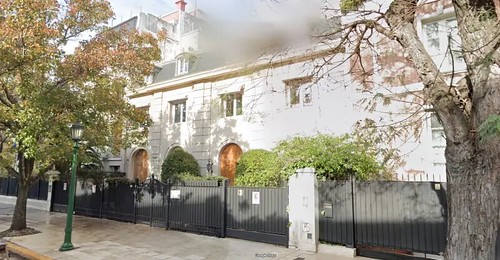
Peter Thiel’s new home in Argentina. Source: NY Postmessianic
Eschatology is one thing, preaching the demise of the state and at the same time making billions from the state is another thing completely.
Started: Fri, Oct 2, 2026

No comments:
Post a Comment