Version 3: Sat, Oct 10, 2026

Brazilian President Luiz Inacio Lula da Silva waves to supporters during a presidential election campaign rally in Sao Bernardo do Campo, Sao Paulo state, Brazil, Sunday, Aug. 16, 2026. (AP Photo/Andre Penner)
Brazilian Elections
The first round of the elections in Brazil on October 4 showed Flavio Bolsonaro ahead with 47% and incumbent President da Silva at 45%. [1]
All the polls show a very tight race on the second round on October 25.
We should note that foreign interference is not unusual in elections in Brazil as well as in other Latin America countries. [2]
But as Yogi Berra once said “It ain’t over till it’s over”! Lula has been here before and he is a fighter so let us not write him off just yet!
No matter what the results of the second round, President Lula and the Workers’ Party can be proud of Law No. 15,506/2026 on critical and strategic minerals.
National Policy on Critical and Strategic Minerals (PNMCE)
Starting in 2023 China started introducing export controls for minerals that are produced and/or processed in the coutry including rare earth metals. [3]
Western countries started to look for alternative sources. According to the US Geological Survey Brazil is number two in the world with 23% in rare earth deposits, behind only to China. [4]
The increase in demand led the Brazilian government to work on a new legal framework to streamline and speed up the approval and licecing process for the mineral projects. Here is how a Brazilian legal firm [5] describes it:
President of Brazil, Luiz Inácio Lula da Silva signed into law, on 09/16/2026, Bill No. 2780/2024, which establishes the National Policy on Critical and Strategic Minerals (PNMCE). The bill had already been approved by the Federal Senate on 09/02/2026 without substantive amendments to the text passed by the parliament (approved on 05/06/2026), with only drafting amendments having been adopted. With the full presidential signature and no vetoes, the measure was enacted as Law No. 15,506 of 2026.
On the same date, Decree No. 13,118/2026 was published, which regulates Law No. 15,506/2026, to establish provisions regarding the National Council for the Industrialization of Critical and Strategic Minerals (CIMCE), and to create the Advisory Group on Critical and Strategic Minerals.
The new law stregthens the federal government to better protect the interests of the country. Certain transactions must go through a screening and approval process. More specifically the following will require approval: [5]
- change of corporate control, whether direct or indirect, including
through corporate reorganization, of a company holding mining rights to
critical and strategic minerals (subsection I);
- access to geological information of strategic interest or material participation/significant influence by foreign legal entities (subsection II);
These two provisions would have stopped two widely publicized cases in Brazil: the sale of Serra Verde, and the Goias-USA agreement. Common denominator to both: Ronaldo Caiado.
Note, it took two years for the bill to become law, but it is considered fast. [6]
There are reasonable but manageable criticisms of the new law [7] and [8].
The Goias - USA Agreement
Dias and Angelo on Tech Policy Press: [9]
While the Brazilian federal government was preparing a national rare earths policy aimed at positioning the country as a global leader in the sector — on its own sovereign terms — the governor of Goiás, the Brazilian state home to the largest reserves of these minerals critical to the technology industry, moved first. He not only enacted his own policy, sidelining the Lula administration, but also signed an agreement with the United States that squarely served President Donald Trump’s ambitions.
[…] the Goiás government signed a memorandum of understanding with the US stipulating that strategic geological data would be “jointly owned” by Goiás and the US, and could be granted on an exclusive basis to entities designated by the US, drawing sharp criticism over the transfer of strategic Brazilian information and raising serious questions about national sovereignty.
and they continued:
By launching its own policy ahead of the federal government, Goiás put itself on a collision course with Lula, who is also a presidential candidate in the upcoming election. For Lula’s allies, Caiado opened the door to US interests and ran roughshod over the Brazilian Constitution, which establishes that mineral resources are federal property.
Caiado used this to launch himself to the national scene and run for president. It would be interesting to find out how he funded his campaign.
The Sale of Serra Verde Mining
Gabriela Sá Pessoa et al. on Associated Press News: [10]
In February, the only company producing rare earths in Brazil, Serra Verde, secured a $565 million financing package from the U.S. International Development Finance Corporation. In April, USA Rare Earth announced an agreement to acquire Serra Verde for about $2.8 billion, three months after the U.S. Department of Commerce announced plans to provide up to $1.6 billion in support to USA Rare Earth. The department receives over 16 million shares in the deal, finalized in June.
Serra Verde is the only producer outside Asia with capacity to supply all four magnetic rare earth elements — neodymium, praseodymium, dysprosium and terbium — essential to automotive, medical, renewable energy, electronics, robotics, defense and aerospace industries.
“The Western rare earth sector stands at a critical inflection point, as governments and strategic industries urgently seek reliable sources of critical rare earths — particularly scarce heavy rare earths,” Thras Moraitis, CEO of Serra Verde Group, said in a statement during the acquisition.
Gabriel Garcia on Mining.com: [11]
US-based USA Rare Earth (Nasdaq: USAR) agreed in April to acquire Serra Verde, Brazil’s only large-scale rare earth producer, for about $2.8 billion. The Pela Ema operation in Goiás state produces all four magnetic rare earths — neodymium, praseodymium, dysprosium and terbium — and the buyer has framed the deal as part of its plan to build an integrated mine-to-magnet supply chain outside China.
The deal has also drawn concern inside Brazil’s government because Serra Verde’s 15-year offtake commits its first-stage output of mixed rare earth carbonate abroad, while Brasília wants the country to develop domestic capacity to separate individual rare earth oxides.
At the time the transaction was agreed, however, the government lacked the specific investment-screening mechanism now contemplated by the critical minerals bill.
On September 4, 2026 it was announced that Serra Verde and USA Rare Earths merged [12]. Could an IPO be far behind?
This is the kind of business dealings that the new law is meant to examine more closely and possibly block!
For example Brazil could have blocked the deal unless they get say 10% of the new company after the merger.

Dysprosium
chips by
Materialscientist
at
en.wikipedia,
CC
BY-SA 3.0,
Link
The Bigger Picture, China and BRICS
What is all about then?
Dias and Angelo on Tech Policy Press: [9]
Trump’s race to secure, increase and improve US stockpiles and access to critical minerals and rare earths is not driven by any desire to bet on the energy transition, electrification or climate action — he has repeatedly said he does not believe in climate change and has taken aggressive steps to unravel what the US once built toward fulfilling its commitments under the Paris Agreement.
Rare earths and other scarce minerals are essential to the defense and technology industries — two sectors that form a crucial pillar of support for Trump. Without these contested inputs, both the military-industrial complex and the artificial intelligence data center boom risk serious disruption, a result Trump and his allies are working relentlessly to prevent.
And reaching a point of real impact on global supply chains will not come quickly for the US or any other nation. The US currently depends on China for 70% of its rare earths, 50% of its graphite and 55% of its antimony, among others. Trump does not want Chinese market maneuvers to trigger scarcity episodes that could damage American industry — and, by extension, his electoral base and political capital.
He has therefore invested in bilateral agreements to “build secure and resilient critical mineral supply chains” and “anchor strategic links in the global technology supply chain,” as embodied in the Critical Minerals Ministerial, which convened the subgroup of countries that has come to be known as the Pax Silica.
NO1 on his Substack post: [3]
China’s rare earth dominance is well-known by now. The 2010 fishing boat incident with Japan, the Deng Xiaoping quote about “the Middle East has oil, China has rare earths”, the general awareness that these elements matter for technology. What’s less understood is the distinction between light rare earths and heavy rare earths, and why that distinction determines whether American missiles can fly.
Light rare earths - lanthanum, cerium, neodymium - are not rare, they’re actually relative abundant. China dominates production but alternative sources exist in the US (Mountain Pass, California), Australia (Lynas), and elsewhere. Heavy rare earths - dysprosium, terbium, yttrium - are different. China controls 99-100% of global supply with no commercial production anywhere else on Earth.
Heavy rare earths enable high-temperature permanent magnets that operate above 200°C. Neodymium-iron-boron magnets work fine for consumer electronics and electric vehicles. But missile guidance systems? Fighter jet actuators? Precision munitions? Those operate in thermal environments that demagnetize standard NdFeB magnets. You need dysprosium-enhanced magnets that maintain magnetic properties at extreme temperatures.
What would China do?
- On the one hand it is not in China’s interest to help the development of the mining industry in a country that will compete with Chinese companies and supply its opponents.
- On the other hand this is not an all-or-nothing situation. We should not underestimate China’s ability for long term strategic thinking, and that may mean at least partial processing of minerals in Brazil. Brazil is after all a fellow BRICS country and it is in the interest of China to help a country be independent of Western influence and control.
It should be mentioned that China has developed technologies ahead of the West in a number of areas, at least for the moment.
Electrokinetic Rare Earth Mining
Vijay Prashad on CounterCurrents.org: [13]
China’s rise in the rare-earth sector began with highly damaging mining practices, including extensive ammonium-salt leaching.
Chinese researchers and public institutions have since invested in reducing these harms. A team of Chinese scientists developed electrokinetic mining, which uses controlled electric fields to move rare-earth ions through weathered clay. Initial trials reported 2.6 times greater recovery, an 80 percent reduction in leaching agents, and 70 percent fewer metallic impurities than conventional techniques.
The technique has now moved beyond the laboratory. An industrial-scale Chinese trial conducted on 5,000 tonnes of ore achieved 95 percent rare-earth recovery while reducing ammonia emissions by 95 percent. Its developers also found the method economically viable compared with conventional extraction.
Electrokinetic extraction is not impact-free, nor does it replace the downstream separation and magnet industries.
But it demonstrates an important point: there is no technical justification for Brazil to accept yesterday’s water-intensive and chemically wasteful extraction systems while foreign owners reserve advanced research, refining, and manufacturing for themselves. The technology chosen for a mine is a political decision about who bears the costs and who acquires knowledge.
Thorium[14]
We have highlighted China’s success with Thorium energy production earlier this year. [14]
According to Wikipedia citing an OECD report, Brazil is second to India with approximately 10% of global thorium reserves. So there is significant potential for future collaboration between China and Brazil for energy production.
Of course all bets are off if Bolsonaro wins.
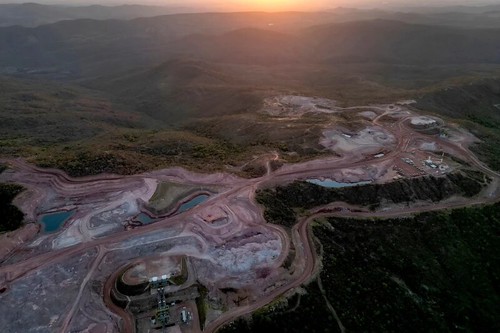
A mine operated by Serra Verde Mining digs for rare earth elements including neodymium, praseodymium, terbium and dysprosium, which are essential for the production of permanent magnets, in Minacu, Goias state, Brazil, July 28, 2025. (AP Photo/Eraldo Peres, File) - Source: APNews.com
Notes
[1] Brazilian Elections
(Phillips 2026) Brazil’s presidential race goes to second round as Flávio Bolsonaro leads incumbent Lula https://www.theguardian.com/world/2026/oct/05/brazil-presidential-race-election-result-second-round-lula-flavio-bolsonaro by Tom Phillips and Tiago Rogero in Rio de Janeiro - Guardian - 5 Oct 2026 - Archive https://archive.ph/O4klR
[2] Interference in Brazilian Elections
Argentinian Fernando Cerimedo, a Trump connected political operative has played an important role in the previous Brazilian presidential election and almost certainly in the current one. The following article documents his career:
(RI 2026) How to Steal a Hemisphere https://reactionary.international/investigations/how-to-steal-a-hemisphere/en/ by Reactionary.International - Archive https://archive.is/U4SYu
There are two sections in this report about Brazil and Fernando Cerimedo:
- Bots, fake news, and a visit from Eduardo Bolsonaro (the 2022 election)
- The Assault Continues (current election)
Cerimedo was arrested late late August on suspicion of attempted femicide of his former partner Nadia Beller and for drug trafficking.
Another great article:
(Lobo 2026) Case of pro-Trump operative Cerimedo opens Pandora’s box of corruption, election interference and drug ties across Latin America https://www.wsws.org/en/articles/2026/09/01/vyag-s01.html by Andrea Lobo - WSWS - Aug 31, 2026 - Archive https://archive.is/67dqQ
But it gets even nastier:
(Corbishley 2026) Bolivia’s Attorney General, Who Is (Or Was) Investigating “MAGA’s Man in Latin America”, Was Just “Kidnapped” by Security Forces https://www.nakedcapitalism.com/2026/10/bolivias-attorney-general-who-is-investigating-magas-man-in-latin-america-was-just-abducted-by-intelligence-officers.html by Nick Corbishley - Naked Capitalism - October 2, 2026 - Archive https://archive.ph/aMhGd
Note: the US have intervened in Brazilia elections before. For more info, search with:
“Operation Brother Sam” Brazil
.jpg#/media/File:Secretary_Rubio_Meets_with_Bolivian_President_(55134047661).jpg)
US
State Dept -
https://www.flickr.com/photos/9364837@N06/55134047661/,
Public Domain,
Link
Marco Rubio left-middle, Fernando Cerimedo right-front.
[3] Rare Earths and the Periodic Table
(NO1 2026) Weaponizing the periodic table: China won this war without firing a shot https://no01.substack.com/p/china-usa by NO1 - Substack - Jan 25, 2026 - Archive: https://archive.is/fkuGv
Useful guide, printed out to 25 pages. The following may be needed to remind you of school chemistry:
(ACS) Periodic Table of Chemical Elements - American Chemical Society https://www.acs.org/education/whatischemistry/periodictable.html PDF 1 page.
[4] US Geological Survey
(USGS 2026) Rare Earths https://pubs.usgs.gov/periodicals/mcs2026/mcs2026-rare-earths.pdf PDF 2 pages - US Geological Survey 2026
(USGS 2026) Mineral Commodity Summaries 2026 - US Geological Survey https://pubs.usgs.gov/publication/mcs2026 PDF 226 pages
Directory listing of dozens of USGS reports on particular minerals: https://pubs.usgs.gov/periodicals/mcs2026/
[5] A Brazilian law firm on the new law
Cescon, Barrieu, Flesch & Barreto Advogados https://cesconbarrieu.com.br/en/
Part of Deep Seek response:
Cescon, Barrieu, Flesch & Barreto Advogados is consistently recognized as one of Brazil’s leading law firms, often included in the “Elite” tier by major legal directories.
(Pettersen 2026) Brazilian National Policy on Critical and Strategic Minerals Signed into Law https://cesconbarrieu.com.br/en/national-policy-on-critical-and-strategic-minerals-signed-into-law/ by Daniel Ribeiro Pettersen et al. - Cescon Barrieu - 22 September 2026 - Archive https://archive.is/9842w
[6] DeepSeek on the Brazilian legislative process
Part of prompt to DeepSeek:
[…] does 2780/2024 mean it was introduced in 2024? And it could be years before it is voted?
Part of DeepSeek response:
[…] However, it should be noted that the actual progress of PL 2780/2024 is very fast: it was introduced in the Chamber of Deputies in 2024, approved by the Chamber and sent to the Senate in May 2026, and the Senate approved it in early September 2026, sending it to the president for signature—the entire process took about two years.
This is relatively fast, mainly because the content of the bill itself had broad consensus and did not trigger extensive amendments in the Senate.
[7] Repórter Brasil
Repórter Brasil https://reporterbrasil.org.br/jornalismo/english/. Google translation:
Repórter Brasil was founded in 2001 by journalists, social scientists, and educators with the aim of fostering reflection and action regarding violations of the fundamental rights of peoples and workers in Brazil. Through its work, the organization has become one of the most important sources of information on slave labor in the country. Its reporting, journalistic investigations, research, and educational methodologies have been used by leaders in government, the business sector, and civil society as tools to combat modern-day slavery—a problem affecting thousands of people.
(Gomes 2026) Analysis: National Critical Minerals Policy does not guarantee a transition without sacrifice zones https://reporterbrasil.org.br/2026/09/national-critical-minerals-policy-transition-sacrifice-zones/ by Marcel Gomes - sep 18, 2026 - Archive https://archive.is/6Aolx
Marcel Gomes, PhD in Energy Systems Planning from the University of Campinas (Unicamp), is Executive Director of Repórter Brasil.
Gomes’ criticism of the the membership of CIMCE, on Reporter Brasil:
The National Council for the Industrialization of Critical and Strategic Minerals will be linked to the Presidency of the Republic. Its core will consist of 15 ministers, along with representatives of states, municipalities, the private sector and universities. Civil society does not have a permanent representative with voting rights.
We are in an election year. If there are concerns about the current government, which is more open to dialogue with civil society, what could happen under a new government aligned with more reactionary sectors of society and business?
Put it another way if Bolsonaro wins there would be a problem.
Participation by civil society is important to voice concerns, but decisions are probably taken by majority rule. But that would mean be able to block decisions which no government will allow.
[8] Op-Ed on Mining.com
Adriano Drummond Trindade is a Brazilian lawyer specializing in the mining sector, partner of Mattos Filho Advogados.
(Trindade 2026) Op-Ed: Brazil’s critical minerals push comes with a catch https://www.mining.com/op-ed-brazils-critical-minerals-push-comes-with-a-catch/ by Adriano Drummond Trindade - Mining.com - September 10, 2026 - Archive https://archive.ph/9dsbl
These measures recognize one of the central challenges facing mineral-producing countries: capturing more economic value than can be obtained simply by extracting and exporting ore. > > Yet there is an important distinction between encouraging domestic processing and making incentives dependent upon it.
A processing industry becomes competitive because the economics support it: energy, infrastructure, technology, logistics, financing, markets and scale all matter. Legislation can improve those conditions, but it cannot make them irrelevant.
If access to otherwise attractive mining incentives depends too heavily on downstream commitments that are not commercially viable, Brazil risks weakening the investment proposition at the upstream stage without necessarily creating a competitive processing industry downstream.
That would defeat the policy’s purpose.
Seems to me the law seeks to attract interest from serious investors, possibly conected with state entities that ca afford the outlay because they can appraciate the risk of not having the minerals. Which means to me Brazil could and should hang tough in dealing with predators, and the new law gives the tools to do just that!
[9] Tech Policy Press
Tech Policy Press https://www.techpolicy.press/ is a 501(c)(3) non-profit media and community venture intended to provoke new ideas, debate and discussion at the intersection of technology and democracy.
Tatiana Dias is a Brazilian investigative journalist specializing in technopolitics and human rights. She serves as Program Director at CTRL+Z, a nonprofit focused on big tech accountability.
Maurício Angelo is the Executive Director of the Mining Observatory https://observatoriodamineracao.com.br/, a journalism and research organization founded in 2015 and focused on the extractive sector. He is a PhD candidate in Environmental Science at the University of São Paulo (PROCAM-USP).
(Dias 2026) How a Brazilian Governor Turned Rare Earths Into a Campaign—and Washington Into a Partner https://www.techpolicy.press/how-a-brazilian-governor-turned-rare-earths-into-a-campaign-and-washington-into-a-partner/ by Tatiana Dias and Maurício Angelo -TechPolicy - Aug 17, 2026 - Archive https://archive.ph/XhJom
Great article on the machinations of Ronaldo Caiado!
[10] Associated Press
(Pessoa 2026) The US and others turn to Brazil for rare earths, raising environmental concerns https://apnews.com/article/brazil-energy-rare-earth-mining-amazon-rainforest-d247150492581197cfa9614c9437c4c2 by Gabriela Sá Pessoa, Associated Press / Diego Junqueira And Isabel Harari - Archive https://archive.ph/jU8L3
Diego Junqueira and Isabel Harari are with Reporter Brasil [7]
[11] Mining.com
Gabriel Garcia is a journalist at CNN Brazil, based in Brasília, covering mining, infrastructure and economic policy. He specializes in critical minerals, mining regulation and the geopolitics of global supply chains.
(Garcia 2026) Brazil targets bigger role in critical minerals rush https://www.mining.com/brazil-targets-bigger-role-in-critical-minerals-rush/ by Gabriel García - Mining.com - September 7, 2026 - Archive https://archive.is/zKMur
[12] United States Securities and Exchange Commission
(SEC 2026) USA Rare Earth Completes Combination with Serra Verde Group https://www.sec.gov/Archives/edgar/data/1970622/000121390026097399/ea030400101ex99-1.htm Press Release - Sep 4, 2026 - Archive https://archive.is/TKu6f
Serra Verde is the only scaled producer of all four magnetic and other critical heavy rare earth elements outside Asia. Its mining and processing operation in Goiás, Brazil began production in January 2024 and is currently completing an advanced-stage optimization and commissioning program, with ramp-up expected in the third quarter of 2026. The first stage of this program is expected to reach a run-rate of approximately 4,000 tons per annum (tpa) of total rare earth oxide (TREO) production by the end of 2026. Construction is underway on the second stage of the expansion, targeting average production of 6,400 tpa of TREO, with commissioning expected to begin within 12 months. Longer term, Serra Verde has the potential to double run of mine (ROM) production through a Phase 2 expansion.
Serra Verde joins USA Rare Earth’s existing and planned upstream, midstream and downstream assets in the United States, the United Kingdom and France to create a fully integrated rare earths platform positioned to deliver a reliable supply chain of vital rare earth elements and derivative products aimed at meeting commercial and public sector demand at each stage of the value chain.
[13] Electrokinetic Rare Earth Mining
(Prashad 2026) Brazil Must Not Surrender Its Critical Minerals https://countercurrents.org/2026/08/brazil-must-not-surrender-its-critical-minerals/ by Vijay Prashad - CounterCurrents - Aug 30, 2026 - Archive https://archive.is/aHj31
(Yirka 2025) Electrokinetic rare earth mining technique gets upscaled to industrial levels https://techxplore.com/news/2025-01-electrokinetic-rare-earth-technique-upscaled.html by Bob Yirka - Phys.org - Jan 7, 2025 - Archive https://archive.ph/vNe3l
A team of metallurgists and geochemists at Guangzhou Institute of Geochemistry, working with a mechanical engineer from the Chinese Academy of Sciences, has improved their previous electrokinetic mining technique by scaling it up to industrial levels. In their paper published in Nature Sustainability, the group describes the changes they made to their system, and the results of testing they conducted at a mine.
[14] Thorium
(Metagora 2026) China Sci Tech Update https://metagora.blogspot.com/2026/04/china-sci-tech-update.html
(Wikipedia 2026) Thorium-based nuclear power https://en.wikipedia.org/wiki/Thorium-based_nuclear_power - Archive https://archive.is/cpDVb
World thorium reserves: table of data excerpt from oecd-nea.org (2016)
| Country | Tons | % |
|---|---|---|
| India | 846,000 | 13.31% |
| Brazil | 632,000 | 9.94% |
| Australia | 595,000 | 9.36% |
| US | 595,000 | 9.36% |
| Egypt | 380,000 | 5.98% |
| Turkey | 374,000 | 5.89% |
| Venezuela | 300,000 | 4.72% |
Note: Brazil and Venezuela together around 15% of global thorium reserves.
Digression: Turkiye has about 6%, which should be another reason to re-orient foreign policy towards the east, China and India which also develops thorium technology.

The Sossego Mining Complex in southeastern Pará. (Image courtesy of Vale Base Metals.) - Source: mining.com. Additional information from DeepSeek:
The Sossego Mining Complex primarily produces copper concentrate, with gold recovered as a valuable by-product.
The operation has an annual production capacity of approximately 70,000 tons of copper concentrate with a high grade of around 28%. The ore is mined from open pits and processed on-site before being transported for export.
The copper ore at Sossego also contains gold. Gold is recovered during the processing of the ore, and its value is realized through the sale of the copper concentrate. For instance, a recent project to reprocess a talc stockpile recovered over 6,600 tons of copper along with 4,200 ounces of gold.
Started: Fri, Sep 11, 2026

No comments:
Post a Comment